
When you visit an orthodontist, you might expect them to look at your teeth, check your bite, and talk with you about braces or clear aligners. But there’s another important part of many orthodontic evaluations: dental X-rays.
At Mizrahi Orthodontics in Brooklyn, NY, X-rays can give our orthodontic team valuable information that isn’t visible during a regular visual examination. They allow an orthodontist to look beneath the gums and evaluate the teeth, roots, jawbones, and developing permanent teeth before creating a personalized treatment plan.
If you’re considering braces or clear aligners in Brooklyn, understanding why orthodontic X-rays are taken can help you feel more comfortable and informed about your first visit.
What Do Orthodontic X-Rays Show?
A traditional dental examination allows an orthodontist to see the visible surfaces of your teeth. X-rays provide a different perspective by showing structures beneath the surface.
Depending on the type of X-ray taken, your orthodontist may be able to evaluate:
- The position of tooth roots
- Permanent teeth that have not yet erupted
- Impacted teeth
- Missing teeth
- Crowded teeth
- Jaw development
- The relationship between the upper and lower jaws
- Bone surrounding the teeth
- Tooth development in children and teens
- Certain abnormalities that may not be visible during an oral examination
This information can be particularly important when developing an orthodontic treatment plan.
Why Are X-Rays Important Before Braces?
If you’re considering braces in Brooklyn, your orthodontist needs to understand more than just how your teeth look.
Braces gradually move teeth through the bone. Before treatment begins, your orthodontist needs to evaluate the position and development of your teeth and the surrounding structures.
An X-ray can help your orthodontist determine things such as:
Where are the tooth roots?
The visible part of a tooth is only part of the picture. The roots are located beneath the gums and play an important role in orthodontic treatment.
Are all of the permanent teeth developing normally?
This is especially important for children and teenagers who still have developing permanent teeth.
Are any teeth impacted?
An impacted tooth is a tooth that doesn’t erupt normally into the mouth. Wisdom teeth are commonly associated with impaction, but other teeth can also become impacted.
Is there enough information to safely plan treatment?
Orthodontic treatment is customized for every patient. X-rays can provide information that helps your orthodontist determine the appropriate approach.
Why Do Children Need Orthodontic X-Rays?
Children’s smiles are constantly changing.
Baby teeth are being lost, permanent teeth are developing, and the jaws are growing. An orthodontist may use X-rays to monitor this development and identify potential problems before they become more complicated.
For example, an X-ray may help reveal:
- Permanent teeth that haven’t erupted yet
- Teeth developing in an unusual position
- Missing permanent teeth
- Significant crowding
- Impacted teeth
- Differences in jaw development
This is one reason the American Association of Orthodontists recommends that children have their first orthodontic evaluation by age 7.
An early orthodontic evaluation does not automatically mean a child needs braces. Instead, it gives an orthodontist an opportunity to monitor development and determine whether treatment is recommended now, later, or not at all.
What Is a Panoramic X-Ray?
You may hear your orthodontist mention a panoramic X-ray, sometimes called a panoramic radiograph.
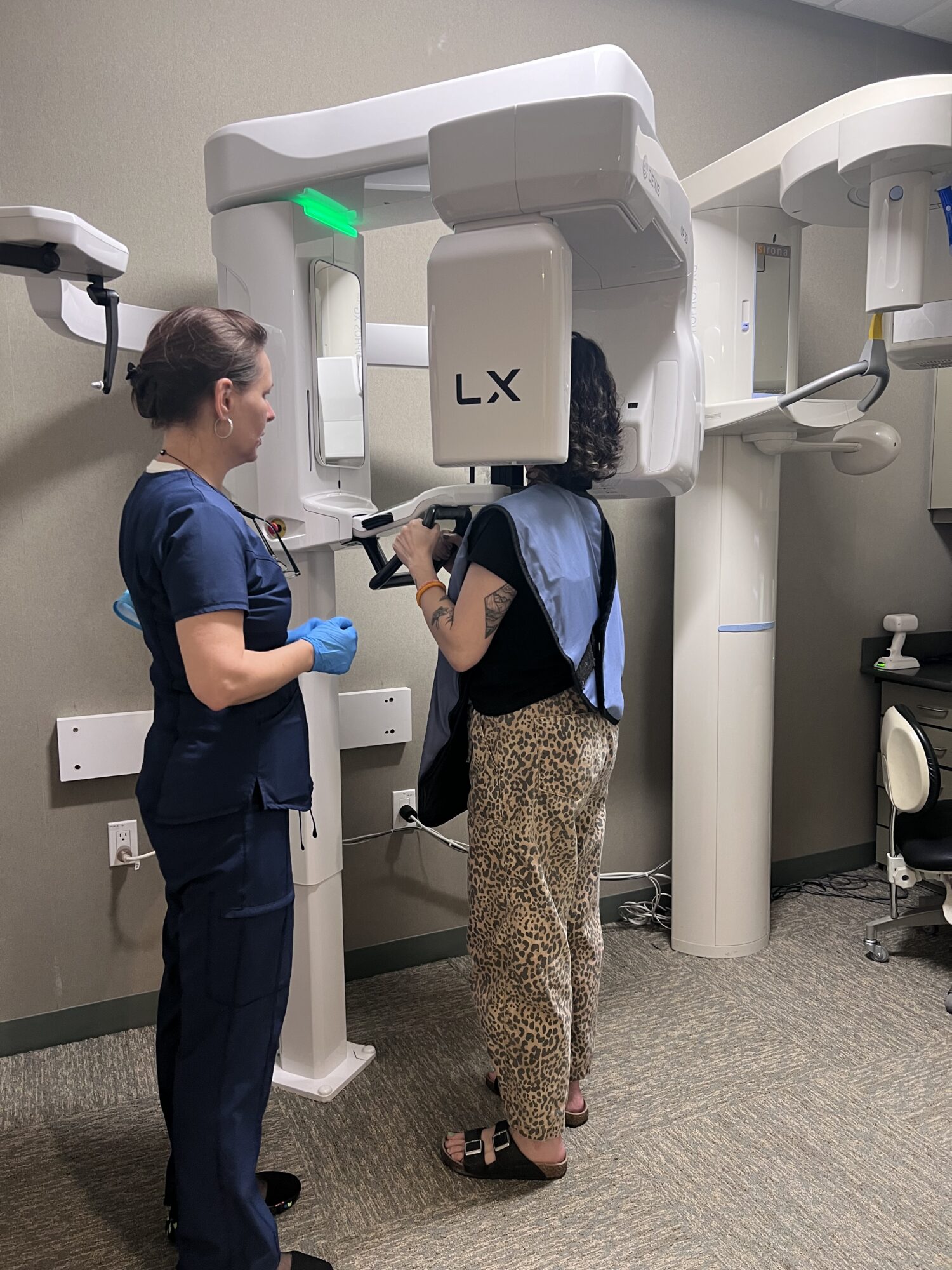
A panoramic X-ray captures a broad view of the teeth and jaws in a single image. It can provide an overview of the developing teeth, erupted teeth, roots, and jaw structures.
This type of X-ray can be especially useful in orthodontics because your orthodontist is evaluating the relationship between many teeth and the surrounding structures—not just one individual tooth.
What Is a Cephalometric X-Ray?
Another type of X-ray commonly used in orthodontics is a cephalometric X-ray, sometimes called a cephalogram.
A cephalometric image provides a side view of the head and can help an orthodontist evaluate the relationship between the teeth, jaws, and facial structures.
This information can be useful when evaluating concerns such as:
- Overbites
- Underbites
- Jaw discrepancies
- Facial growth patterns
- Tooth positioning
- Overall bite relationships
Together with an examination, photographs, scans, and other diagnostic information, X-rays can help your orthodontist create a more complete picture of your smile.
Do I Need an X-Ray at Every Orthodontic Appointment?
Not necessarily.
X-rays aren’t automatically needed at every orthodontic appointment. Your orthodontist determines when imaging is appropriate based on your individual treatment needs, dental development, medical and dental history, and previous X-rays.
At Mizrahi Orthodontics, we believe diagnostic imaging should be used thoughtfully and when it provides information that can help with diagnosis, treatment planning, or monitoring.
If you have recently had dental X-rays taken by your general dentist, let your orthodontist know. In some situations, existing images may provide useful information.
Are Orthodontic X-Rays Safe?
Modern dental X-ray equipment uses very small amounts of radiation. Dental professionals follow established safety guidelines and use appropriate protective measures.
Your orthodontist will recommend X-rays when the diagnostic information they provide is important for your care.
If you have questions about an X-ray your orthodontist recommends, don’t hesitate to ask. Understanding why an image is being taken is an important part of being an informed patient.
Can X-Rays Detect Impacted Teeth?
Yes. Identifying impacted teeth is one of the reasons orthodontists may use X-rays.
An impacted tooth is one that is blocked from erupting normally. While some impacted teeth may eventually erupt on their own, others may require orthodontic treatment or additional dental care.
X-rays allow an orthodontist to see teeth that are still beneath the gums and evaluate their position relative to surrounding teeth and structures.
This can be particularly important for young patients whose permanent teeth are still developing.
X-Rays Help Your Orthodontist Look Beyond Straight Teeth
Orthodontics isn’t simply about making teeth look straight.
A comprehensive orthodontic evaluation considers:
- Tooth alignment
- Tooth roots
- Bite
- Jaw relationships
- Facial growth
- Tooth development
- Available space
- Overall oral health
X-rays are one piece of that bigger picture.
The goal is to understand what’s happening beneath the surface so your orthodontist can develop a treatment plan that is appropriate for your individual smile.
Why Choose Mizrahi Orthodontics in Brooklyn?
At Mizrahi Orthodontics, we provide personalized orthodontic care for children, teens, and adults in Brooklyn, New York.
Located on Avenue U in Brooklyn, our practice provides orthodontic treatment options including traditional braces and clear aligners. We believe every patient deserves a treatment plan based on their individual needs—not a one-size-fits-all approach.
Whether you’re looking for an orthodontist near Avenue U, exploring braces for your child, considering adult orthodontic treatment, or wondering whether clear aligners could be right for you, a comprehensive orthodontic evaluation is an important first step.
Schedule an Orthodontic Consultation in Brooklyn
Thinking about braces or clear aligners? Mizrahi Orthodontics on Avenue U in Brooklyn, NY can evaluate your smile, bite, and dental development to determine the best treatment options for your individual needs.
Contact Mizrahi Orthodontics today to schedule your consultation and take the first step toward a healthier, more confident smile.